10th Prime Minister of Canada
W. L. Mackenzie King
Liberal prime minister of Canada, 1921–1926, 1926–1930 and 1935–1948.
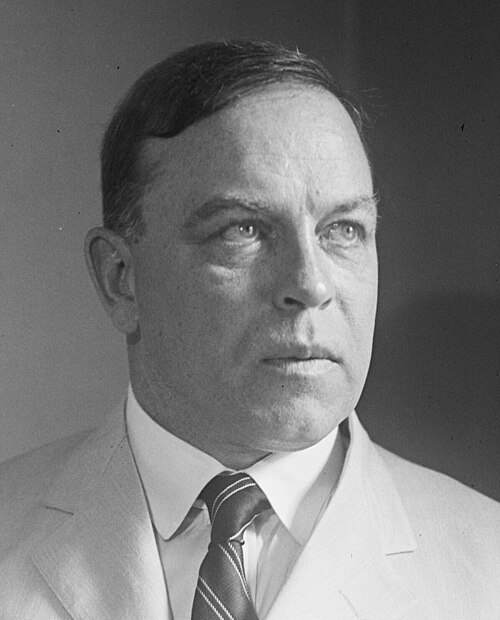
Biography
William Lyon Mackenzie King was born on December 17, 1874, in Berlin, Ontario, now Kitchener. His mother was a daughter of William Lyon Mackenzie, who led the Upper Canada Rebellion of 1837. King earned three degrees from the University of Toronto, including a law degree, and then studied economics and social questions at the University of Chicago, and at Harvard University, which later awarded him a doctorate.
In 1900 King became the first deputy minister of the new federal Department of Labour and editor of the Labour Gazette,. He was elected to the House of Commons for Waterloo North in 1908 and became Canada's first full minister of labour in 1909, but he lost his seat when Wilfrid Laurier's Liberals were defeated in 1911. From 1914 he worked as an industrial relations adviser for the Rockefeller Foundation in the United States. He ran again in 1917 and was defeated.
After Laurier's death, King won the Liberal leadership in August 1919 at the party's first leadership convention and entered the House through a by-election in Prince, Prince Edward Island. He later represented York North, Prince Albert and Glengarry. The Liberals won the election of December 6, 1921, and he became prime minister on December 29, 1921. His government relied at times on support from the Progressive Party. In 1923 Canada signed the Halibut Treaty with the United States on its own authority.
In the 1925 election the Conservatives won more seats, but King stayed in office with Progressive support. In June 1926, facing a censure vote over a customs department scandal, he asked Governor General Lord Byng to dissolve Parliament. Byng refused and invited Arthur Meighen to form a government, which was defeated within days. King made the governor general's role a central issue and won the election that September. At the Imperial Conference of 1926, the Balfour Declaration recognized the dominions as equal in status with Britain. His government introduced federal old age pensions in 1927. The Liberals lost the 1930 election to R. B. Bennett.
King returned to office with a large majority in October 1935. His government signed trade agreements with the United States, brought the Bank of Canada under full public ownership and appointed the Royal Commission on Dominion-Provincial Relations. Canada declared war on Germany on September 10, 1939, by a separate decision of its own Parliament. King won another majority in 1940 and agreed with President Franklin Roosevelt that year on joint North American defence. A national plebiscite in 1942 released the government from its pledge not to conscript for overseas service, and in November 1944, after a shortage of infantry reinforcements, King agreed to send conscripts overseas. During the war his government also removed Japanese Canadians from the British Columbia coast.
The government introduced unemployment insurance in 1940, after a constitutional amendment, and family allowances in 1944. The Liberals won a reduced majority in June 1945, though King lost his own seat and returned through a by-election. The Canadian Citizenship Act, which created Canadian citizenship as a legal status, took effect on January 1, 1947. King retired on November 15, 1948, after more than 21 years as prime minister, the longest tenure in Canadian history. He never married, and his detailed private diaries, published after his death, revealed an interest in spiritualism. He died at his Kingsmere estate in Quebec on July 22, 1950, and was buried in Toronto.
Public debt while in office
1921–1926
- Debt to GDP, taking office
- 74.1% (end-1921)
- Leaving office
- 64.9% (end-1925)
- Change
- -9.2 points of GDP
1926–1930
- Debt to GDP, taking office
- 62.9% (end-1926)
- Leaving office
- 60.8% (end-1930)
- Change
- -2.1 points of GDP
1935–1948
- Debt to GDP, taking office
- 105.2% (end-1935)
- Leaving office
- 113% (end-1948)
- Change
- +7.8 points of GDP
Gross public debt of all levels of government as a share of GDP at the year-end nearest each change of prime minister (IMF). Compare every prime minister.