7th Prime Minister of Canada
Wilfrid Laurier
Liberal prime minister of Canada, 1896–1911.
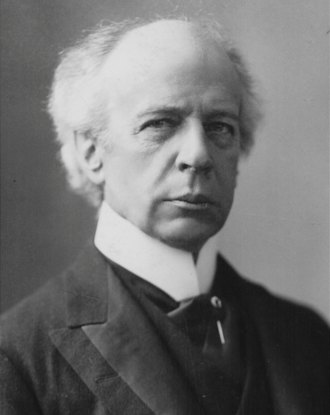
Biography
Sir Wilfrid Laurier was Canada's seventh prime minister, serving from July 1896 to October 1911, the longest unbroken term of any prime minister. He was born on 20 November 1841 in Saint-Lin, Canada East (now Quebec), and was the first francophone to lead the country. As a boy he spent time at an English-speaking school in New Glasgow, Quebec, where he became fluent in English. He studied at the Collège de L'Assomption and earned a law degree at McGill University in 1864.
Laurier practised law in Montreal and was active in the reform-minded Rouge movement. Suffering from poor health, he moved in 1867 to the Arthabaska region of the Eastern Townships, where he edited a Liberal newspaper and continued his law practice. In 1868 he married Zoé Lafontaine. He was elected to the Quebec legislature in 1871 and moved to the House of Commons in 1874 as member for Drummond–Arthabaska.
He became known as a gifted speaker, and in 1877 he gave a widely noted address in Quebec City arguing that liberalism in Canada followed British reform traditions and was compatible with Catholic faith, at a time when parts of the clergy opposed the Liberals. That year Alexander Mackenzie made him minister of inland revenue. Defeated in the by-election that followed his appointment, he won a seat in Quebec East, which he held for the rest of his life. In 1887 he succeeded Edward Blake as Liberal leader. He lost the 1891 election, fought on a policy of unrestricted reciprocity with the United States.
Laurier won the 1896 election and went on to win in 1900, 1904 and 1908. He settled the Manitoba Schools Question through a compromise with the Manitoba government that allowed limited religious and French-language instruction rather than restoring separate schools. His government sent volunteer contingents to the South African War, a compromise between English Canadians who wanted full participation and French Canadians who opposed it. Under interior minister Clifford Sifton, it promoted immigration on a large scale, and hundreds of thousands of settlers from Britain, the United States and continental Europe came to the Prairies. Alberta and Saskatchewan became provinces in 1905, after a bitter dispute over their school systems.
The government backed two new transcontinental railways, the Grand Trunk Pacific and the National Transcontinental, which later required public rescue. It created the Department of Labour in 1900 and passed the Industrial Disputes Investigation Act in 1907. Treaties 8, 9 and 10 were concluded with First Nations in the North and on the Prairies during these years. Immigration policy was openly restrictive toward Asians: the head tax on Chinese immigrants was raised to $100 in 1900 and to $500 in 1903, a 1908 agreement with Japan limited Japanese immigration, and the continuous journey regulation of 1908 was designed to stop immigration from India.
In 1910 the Naval Service Act created the Royal Canadian Navy, angering both imperialists, who found it too limited, and Quebec nationalists, who feared it would draw Canada into British wars. In 1911 Laurier reached a reciprocity agreement with the United States, and the Conservatives under Robert Borden defeated him in that year's election. He remained Liberal leader in opposition. During the First World War he supported the war effort but opposed conscription, and in 1917 many English-Canadian Liberals left him to join Borden's Union government. His Liberals won most seats in Quebec but few elsewhere.
Laurier was knighted in 1897. He died in Ottawa on 17 February 1919, still leader of the Opposition, and is buried in Notre-Dame Cemetery in Ottawa. He served as Liberal leader for more than 31 years.
Public debt while in office
- Debt to GDP, taking office
- 44.2% (end-1896)
- Leaving office
- 20.7% (end-1911)
- Change
- -23.5 points of GDP
Gross public debt of all levels of government as a share of GDP at the year-end nearest each change of prime minister (IMF). Compare every prime minister.