22nd Prime Minister of Canada
Stephen Harper
Conservative prime minister of Canada, 2006–2015.
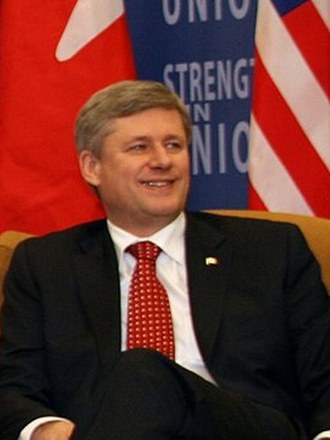
Biography
Stephen Joseph Harper was born on 30 April 1959 in Toronto and grew up in the suburb of Leaside and later in Etobicoke. After a brief period at the University of Toronto he moved to Edmonton, where he worked in the mailroom of an oil company. He then studied economics at the University of Calgary, earning a bachelor's degree in 1985 and a master's degree in 1991. He married Laureen Teskey in 1993; they have two children.
Harper worked as an aide to a Progressive Conservative MP in the mid-1980s but became disillusioned with the party and helped found the Reform Party of Canada in 1987, where he served as its chief policy officer. He lost a contest in Calgary West in 1988 but won the seat in 1993. He did not run again in 1997 and instead became vice-president and then president of the National Citizens Coalition, a conservative advocacy group.
In March 2002 Harper won the leadership of the Canadian Alliance, Reform's successor, and returned to the Commons through a by-election in Calgary Southwest. He negotiated the merger of the Alliance with the Progressive Conservative Party, which created the Conservative Party of Canada in December 2003, and he won its leadership in March 2004. The new party held the Liberals to a minority in the 2004 election.
Harper won a minority government in the election of 23 January 2006 and was sworn in as the 22nd prime minister on 6 February. His government passed the Federal Accountability Act, cut the GST from seven to six and then five per cent, introduced a monthly payment for families with young children, and supported a motion recognizing that the Québécois form a nation within a united Canada. In June 2008 he delivered the federal government's formal apology to former students of residential schools. Although his government had passed a law fixing election dates, he called an early election in October 2008 and won a larger minority.
Facing a proposed coalition of opposition parties, Harper had Parliament prorogued in December 2008. His government's response to the recession included the Economic Action Plan, a program of infrastructure spending and tax measures that produced several years of deficits. Canada's combat mission in Afghanistan continued until 2011. In March 2011 the House found the government in contempt of Parliament and passed a motion of non-confidence, and in the election of 2 May 2011 the Conservatives won a majority.
With a majority, the government abolished the long-gun registry, ended the Canadian Wheat Board's marketing monopoly, withdrew Canada from the Kyoto Protocol, tightened criminal sentencing laws and passed the Anti-terrorism Act, 2015. It also contended with the Senate expense scandal. The government reported a balanced budget for 2014–15. Harper sat for Calgary Heritage after the 2015 redistribution and lost the election of 19 October 2015 to Justin Trudeau's Liberals.
Harper stepped down as Conservative leader after the 2015 defeat and resigned his seat in August 2016. He founded a consulting firm, published a book on populism and trade in 2018, and in that year became chair of the International Democrat Union, an alliance of centre-right parties.
Public debt while in office
- Debt to GDP, taking office
- 70.6% (end-2005)
- Leaving office
- 92% (end-2015)
- Change
- +21.4 points of GDP
- In dollars (at the time)
- $1.00 trillion → $1.83 trillion
Gross public debt of all levels of government as a share of GDP at the year-end nearest each change of prime minister (IMF). Compare every prime minister.