8th Prime Minister of Canada
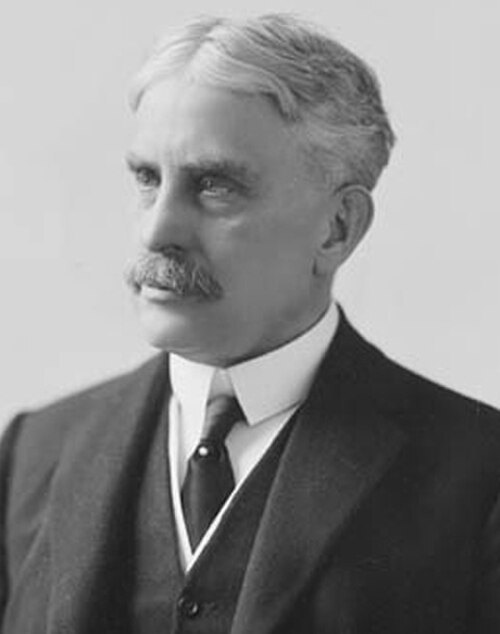
Robert Borden
Conservative prime minister of Canada, 1911–1920.
Biography
Sir Robert Laird Borden was Canada's eighth prime minister, serving from October 1911 to July 1920. He was born on 26 June 1854 in Grand Pré, Nova Scotia, into a farming family. He left school in his mid-teens to teach, first at a local academy in Nova Scotia and then for a time at a school in New Jersey, before returning home to study law.
Borden articled in Halifax and was called to the Nova Scotia bar in 1878. He built one of the province's leading legal practices, arguing many cases before the Supreme Court of Canada and the Judicial Committee of the Privy Council in London. In 1889 he married Laura Bond of Halifax. His reputation as a careful, hard-working lawyer drew the attention of the Conservative Party, including Sir Charles Tupper.
He was elected to the House of Commons for Halifax in 1896, the year the Conservatives lost power to Wilfrid Laurier. Only five years later, in 1901, the Conservative caucus chose him as party leader. He lost the general elections of 1904 and 1908, and in 1904 he was defeated in his own seat, returning to Parliament through a 1905 by-election in Carleton, Ontario. In 1907 he set out a reform program, the Halifax Platform, calling for civil service reform, public ownership of some utilities and an elected Senate. Over his career he represented Halifax, Carleton and, from 1917, Kings in Nova Scotia.
Borden won the 1911 election by opposing the Laurier government's reciprocity agreement with the United States and its Naval Service Act. His proposal to give Britain money to build three warships was passed by the Commons in 1913 but defeated in the Liberal-controlled Senate. When the First World War began in August 1914, his government passed the War Measures Act, which gave cabinet broad emergency powers and was used to intern thousands of people classed as enemy aliens, many of them Ukrainian immigrants.
The war dominated the rest of his time in office. Canada raised a large expeditionary force, and the government introduced a business profits tax in 1916 and the first federal income tax in 1917 to pay for it. As voluntary enlistment fell, Borden introduced conscription through the Military Service Act of 1917. The Wartime Elections Act gave the vote to female relatives of soldiers while removing it from many citizens naturalized from enemy countries. Borden formed a Union government with pro-conscription Liberals and won the December 1917 election, but nearly all of Quebec voted against it. Opposition to conscription remained intense there, and in Easter 1918 troops fired on protesters in Quebec City, killing four civilians.
His government extended the federal vote to most women aged 21 and over in 1918 and began bringing several bankrupt railways under public ownership, the basis of Canadian National Railways. Borden pressed for a greater voice for the dominions in imperial affairs, sat in the Imperial War Cabinet and insisted that Canada sign the Treaty of Versailles in its own right and join the League of Nations as a separate member. At home, his government responded forcefully to the Winnipeg General Strike of 1919, arresting strike leaders and amending immigration and criminal laws to allow the deportation and prosecution of suspected radicals.
Exhausted and in poor health, Borden retired in July 1920 and was succeeded by Arthur Meighen. Afterward he represented Canada at the Washington Naval Conference of 1921–1922, served as chancellor of Queen's University, lectured on Canada's constitutional development and held several business directorships. He was knighted in 1914. He died in Ottawa on 10 June 1937 and is buried in Beechwood Cemetery.
Public debt while in office
- Debt to GDP, taking office
- 20.7% (end-1911)
- Leaving office
- 58.4% (end-1920)
- Change
- +37.7 points of GDP
Gross public debt of all levels of government as a share of GDP at the year-end nearest each change of prime minister (IMF). Compare every prime minister.