11th Prime Minister of Canada
R. B. Bennett
Conservative prime minister of Canada, 1930–1935.
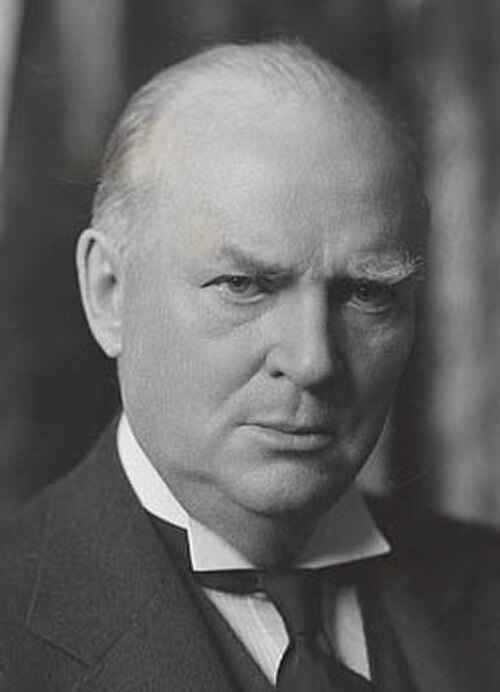
Biography
Richard Bedford Bennett was born on July 3, 1870, in Hopewell Hill, New Brunswick. His family had a background in shipbuilding but had limited means by the time he was growing up. He trained as a teacher and was teaching school while still a teenager, becoming a school principal before saving enough to study law at Dalhousie University, from which he graduated in 1893.
Bennett practised law in Chatham, New Brunswick, and served on the town council. In 1897 he moved to Calgary to become the law partner of James Lougheed, a prominent lawyer and senator. He built a large practice representing the Canadian Pacific Railway and other companies and became wealthy through investments, later inheriting a controlling interest in the E. B. Eddy match and paper company. He never married.
Bennett was elected to the legislative assembly of the North-West Territories in 1898 and, after Alberta became a province, sat in its legislature from 1909 to 1911. He won the federal riding of Calgary in 1911 as a Conservative but did not run in 1917. He served briefly as minister of justice in Arthur Meighen's government in 1921, then lost his seat by a narrow margin in that year's election. He returned to the House for Calgary West in 1925 and was minister of finance during Meighen's short-lived government in 1926.
In October 1927 Bennett won the Conservative leadership at the party's first leadership convention, held in Winnipeg. In the election of July 28, 1930, held as the Great Depression deepened, the Conservatives won a majority, and he was sworn in as prime minister on August 7, 1930. His government called an emergency session of Parliament that approved funds for unemployment relief and raised tariffs sharply. Bennett hosted the Imperial Economic Conference in Ottawa in 1932, which produced preferential trade agreements within the Empire. The Statute of Westminster, passed by the British Parliament in 1931, confirmed Canada's full legislative independence during his term.
As unemployment grew, the government set up work camps for single unemployed men under the Department of National Defence. Protests by camp workers led to the On-to-Ottawa Trek in 1935, which ended in a riot in Regina on July 1. The government also created the Canadian Radio Broadcasting Commission in 1932, passed the Bank of Canada Act in 1934 and established the Canadian Wheat Board and the Prairie Farm Rehabilitation Administration in 1935. In a series of radio addresses in January 1935, Bennett announced a program of reforms that included unemployment insurance, minimum wages and limits on working hours. Parliament passed several of these measures, but courts later ruled much of the legislation beyond federal jurisdiction.
Weakened by the Depression and by the departure of former minister H. H. Stevens, who formed the Reconstruction Party, the Conservatives were heavily defeated by Mackenzie King's Liberals in the election of October 14, 1935, keeping only about 40 seats. Bennett led the Opposition until 1938, when he stepped down as leader. He moved to England in 1939 and lived at Mickleham, Surrey. In 1941 he was made Viscount Bennett, the only Canadian prime minister to be raised to the peerage, and he sat in the House of Lords. He died at Mickleham on June 26, 1947, and was buried there, making him the only prime minister buried outside Canada.
Public debt while in office
- Debt to GDP, taking office
- 60.8% (end-1930)
- Leaving office
- 105.2% (end-1935)
- Change
- +44.4 points of GDP
Gross public debt of all levels of government as a share of GDP at the year-end nearest each change of prime minister (IMF). Compare every prime minister.