14th Prime Minister of Canada
Lester B. Pearson
Liberal prime minister of Canada, 1963–1968.
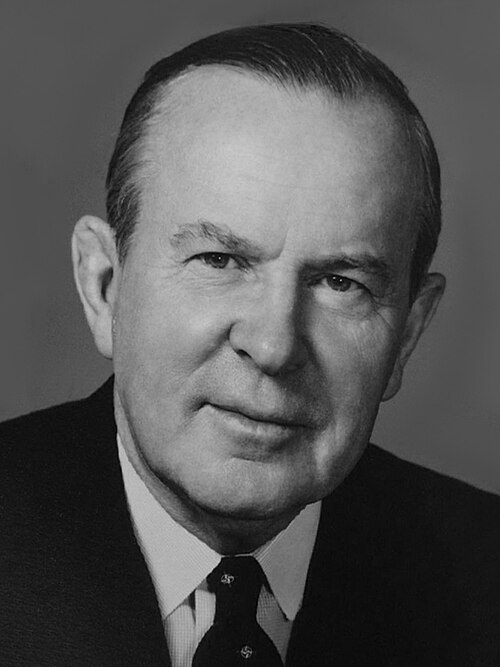
Biography
Lester Bowles Pearson was born on April 23, 1897, in Newtonbrook, Ontario, now part of Toronto, the son of a Methodist minister. He entered Victoria College at the University of Toronto in 1913. During the First World War he served with a Canadian army hospital unit in England and in Salonika, Greece, and later trained as a pilot with the Royal Flying Corps before being injured and sent home. He completed his degree in 1919.
After a short period working in business, Pearson studied history at St John's College, Oxford, and then taught history at the University of Toronto from 1924 to 1928. In 1925 he married Maryon Moody; they had a son and a daughter. In 1928 he joined the Department of External Affairs. He served at the Canadian High Commission in London through the late 1930s and early Second World War, became ambassador to the United States in 1945 and was appointed under-secretary of state for external affairs, the department's senior official, in 1946.
Prime Minister Louis St. Laurent brought Pearson into cabinet as secretary of state for external affairs in September 1948, and he won the Ontario riding of Algoma East in a by-election that fall. He held the riding until he left Parliament. As foreign minister he helped shape the North Atlantic Treaty of 1949, served as president of the United Nations General Assembly in 1952–1953 and, during the Suez Crisis of 1956, proposed the United Nations Emergency Force to separate the opposing armies. He received the Nobel Peace Prize in 1957.
After the Liberals lost power in 1957, Pearson won the party leadership in January 1958. The Liberals were reduced to 48 seats in the election that March, but they recovered ground in 1962. In the election of April 8, 1963, they formed a minority government, and Pearson was sworn in as prime minister on April 22. His government accepted nuclear warheads for Canadian weapons systems, an issue that had divided the previous government. The Liberals won a second minority in November 1965.
Although it never held a majority, Pearson's government passed a large body of social legislation, often with the support of smaller parties. It created the Canada Student Loans program in 1964 and the Canada Pension Plan in 1965, alongside a separate Quebec Pension Plan. It passed the Canada Assistance Plan and the Medical Care Act in 1966, the latter providing federal funding for provincial medical insurance plans. It adopted the maple leaf flag, first raised on February 15, 1965, and signed the Canada–United States Automotive Products Agreement that year. It also established the Royal Commission on Bilingualism and Biculturalism and the Royal Commission on the Status of Women, unified the armed forces, introduced a points system for immigration and created the Order of Canada for the 1967 centennial.
Pearson announced his retirement in December 1967 and was succeeded by Pierre Trudeau in April 1968. He then chaired an international commission on development for the World Bank, which reported in 1969, served as chancellor of Carleton University and worked on his memoirs. He died of cancer at his home in Ottawa on December 27, 1972, and is buried in Wakefield, Quebec.
Public debt while in office
- Debt to GDP, taking office
- 66.6% (end-1962)
- Leaving office
- 57% (end-1967)
- Change
- -9.6 points of GDP
- In dollars (at the time)
- $30.1 billion → $40.5 billion
Gross public debt of all levels of government as a share of GDP at the year-end nearest each change of prime minister (IMF). Compare every prime minister.