23rd Prime Minister of Canada
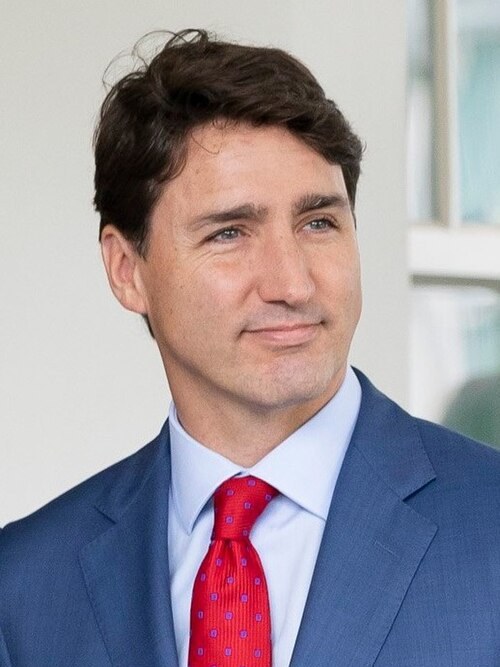
Justin Trudeau
Liberal prime minister of Canada, 2015–2025.
Biography
Justin Pierre James Trudeau was born on 25 December 1971 in Ottawa, the eldest son of Prime Minister Pierre Elliott Trudeau and Margaret Sinclair. He spent his early childhood at 24 Sussex Drive and attended Collège Jean-de-Brébeuf in Montreal. He earned a bachelor's degree in English literature from McGill University in 1994 and a bachelor of education from the University of British Columbia in 1998. He later began studies in engineering and in environmental geography in Montreal but did not complete them.
Trudeau taught French and mathematics at schools in Vancouver before returning to Quebec. He came to national attention with the eulogy he delivered at his father's state funeral in 2000, and he chaired the youth service program Katimavik from 2002 to 2006. He married Sophie Grégoire in 2005; they have three children and announced their separation in 2023.
Trudeau was elected to the House of Commons in 2008 for Papineau, a Montreal riding then held by the Bloc Québécois, and was re-elected there in every election through 2021. After the Liberals fell to third place in 2011, he won the party leadership in April 2013. In the election of 19 October 2015 he led the party from 34 seats to 184, a majority, and he was sworn in as the 23rd prime minister on 4 November 2015 with a cabinet that had equal numbers of women and men.
His first government resettled more than 25,000 Syrian refugees within months, introduced the Canada Child Benefit, raised taxes on the highest incomes, legalized medical assistance in dying, launched a national inquiry into missing and murdered Indigenous women and girls, and legalized recreational cannabis in October 2018. It set a national minimum price on carbon pollution, purchased the Trans Mountain pipeline, and negotiated the Canada–United States–Mexico Agreement to replace NAFTA. The SNC-Lavalin affair led to the resignation of two ministers in 2019, and the Ethics Commissioner found that Trudeau had breached conflict of interest rules.
The Liberals were reduced to a minority in the 2019 election. During the COVID-19 pandemic his government created the Canada Emergency Response Benefit and a wage subsidy for employers, and later organized the national vaccine rollout. He called an early election in 2021 and won a second minority. In February 2022 his government invoked the Emergencies Act for the first time to end blockades in Ottawa and at border crossings. A confidence-and-supply agreement with the New Democratic Party in 2022 led to a national dental care plan and a first pharmacare law, and agreements with the provinces set out to lower child care fees to an average of ten dollars a day.
By 2024 the government faced rising living costs, falling poll numbers and calls from within the caucus for a change of leader. After the resignation of Finance Minister Chrystia Freeland in December 2024, Trudeau announced on 6 January 2025 that he would step down once a new leader was chosen, and Parliament was prorogued. He left office on 14 March 2025, when Mark Carney was sworn in, and did not stand in the April 2025 election, ending his time as MP for Papineau.
Public debt while in office
- Debt to GDP, taking office
- 92% (end-2015)
- Leaving office
- 110.8% (end-2024)
- Change
- +18.8 points of GDP
- In dollars (at the time)
- $1.83 trillion → $3.44 trillion
Gross public debt of all levels of government as a share of GDP at the year-end nearest each change of prime minister (IMF). Compare every prime minister.