4th Prime Minister of Canada
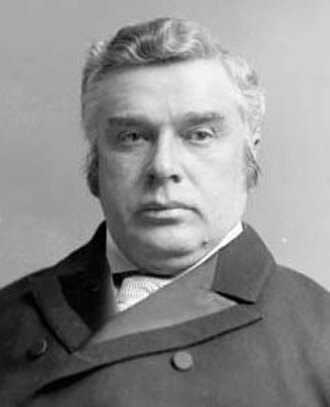
John Thompson
Liberal–Conservative prime minister of Canada, 1892–1894.
Biography
Sir John Sparrow David Thompson was Canada's fourth prime minister, serving from December 1892 until his death in December 1894. He was born in Halifax on 10 November 1845, the son of an Irish-born civil servant and newspaper writer. He was raised a Methodist and in 1871 converted to Roman Catholicism, the faith of his wife, Annie Affleck, whom he had married in 1870. He became Canada's first Catholic prime minister.
Thompson studied law in Halifax and was called to the bar in 1865. He became known as a skilled courtroom lawyer and served on Halifax city council and the city school board. In 1877 he was elected to the Nova Scotia legislature for Antigonish and became attorney general the following year. He was briefly premier in 1882, but his government was defeated at the polls that year, and he was then appointed a judge of the Supreme Court of Nova Scotia.
In 1885 John A. Macdonald persuaded him to leave the bench and become federal minister of justice. He won a by-election in Antigonish, which he represented for the rest of his life. In 1886 he defended the government's decision to carry out the execution of Louis Riel in a major Commons speech. As justice minister he brought in the first Criminal Code of Canada, enacted in 1892, which gathered criminal law into a single statute. He also served as a British arbitrator in the Bering Sea dispute with the United States over seal hunting, which was decided in Paris in 1893. He was knighted in 1888.
After Macdonald's death in 1891, Thompson was widely seen as the most capable minister, but he declined the leadership, partly because his conversion had made him a target of anti-Catholic feeling among some Protestant Conservatives. He led the government in the Commons under Sir John Abbott and became prime minister himself when Abbott retired in December 1892.
As prime minister he worked to restore the government's reputation after a series of corruption scandals and to manage the Manitoba Schools Question, which he preferred to see settled by the courts. His government hosted the Colonial Conference of 1894 in Ottawa, which discussed imperial trade and communications. In late 1894 he travelled to Britain, and on 12 December, shortly after being sworn into the Imperial Privy Council at Windsor Castle, he collapsed and died of a heart attack at the age of 49. His body was returned to Canada aboard a Royal Navy warship, and after a state funeral he was buried in Holy Cross Cemetery in Halifax.
Public debt while in office
- Debt to GDP, taking office
- 37.6% (end-1892)
- Leaving office
- 42.4% (end-1894)
- Change
- +4.8 points of GDP
Gross public debt of all levels of government as a share of GDP at the year-end nearest each change of prime minister (IMF). Compare every prime minister.