13th Prime Minister of Canada
John Diefenbaker
Progressive Conservative prime minister of Canada, 1957–1963.
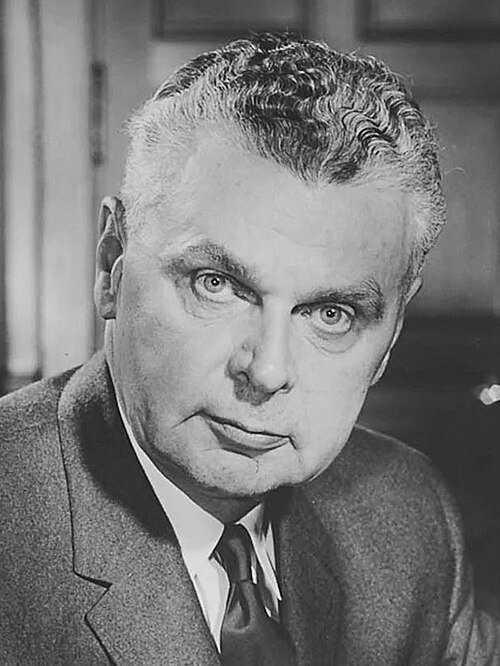
Biography
John George Diefenbaker was born on September 18, 1895, in Neustadt, Ontario. In 1903 his family moved west to what is now Saskatchewan, homesteading near Borden before settling in Saskatoon in 1910. He studied at the University of Saskatchewan, earning a bachelor's degree in 1915, a master's degree in 1916 and a law degree in 1919. He was commissioned as an officer during the First World War and went overseas in 1916, but he was sent home for medical reasons the following year.
Diefenbaker opened a law practice in Wakaw, Saskatchewan, in 1919 and moved to Prince Albert in 1924. He became known as a criminal defence lawyer and took on many murder cases. His early political career was marked by defeats: he lost federal elections in 1925 and 1926, the latter against Mackenzie King in Prince Albert, as well as a provincial election in 1929 and a race for mayor of Prince Albert in 1933. He led the Saskatchewan Conservatives from 1936, but the party won no seats in the 1938 provincial election. He married Edna Brower in 1929; after her death in 1951 he married Olive Palmer in 1953.
Diefenbaker was elected to the House of Commons for Lake Centre, Saskatchewan, in 1940, and from 1953 represented Prince Albert. He ran unsuccessfully for the Progressive Conservative leadership in 1942 and 1948 before winning it in December 1956. In the election of June 10, 1957, the Progressive Conservatives won the most seats, ending 22 years of Liberal government, and he was sworn in as prime minister on June 21 at the head of a minority. He called another election for March 31, 1958, and won 208 of 265 seats, the largest majority to that time.
His government appointed Ellen Fairclough as the first woman in a federal cabinet in 1957 and named James Gladstone as the first First Nations senator in 1958. In 1960 Parliament passed the Canadian Bill of Rights and extended the federal vote to status First Nations people without requiring them to give up their status. The government also signed the NORAD air defence agreement with the United States, introduced simultaneous interpretation in the House of Commons, sold large quantities of wheat to China. In 1959 it cancelled the Avro Arrow fighter program, and the job losses that followed drew lasting controversy. At the 1961 Commonwealth conference Diefenbaker opposed South Africa's apartheid policies, and South Africa withdrew from the Commonwealth.
The Progressive Conservatives were reduced to a minority in the election of June 18, 1962. Divisions within the cabinet over whether to accept nuclear warheads for Bomarc missiles and other weapons, and strained relations with the United States, weakened the government. It was defeated on a non-confidence motion in February 1963, and the Liberals under Lester B. Pearson won the election of April 8, 1963.
Diefenbaker remained party leader as leader of the Opposition and held the Liberals to minorities in 1963 and 1965. Facing growing pressure within the party, he lost the leadership to Robert Stanfield at a convention in 1967. He continued to sit as the member for Prince Albert, wrote a three-volume memoir and was re-elected for the last time in May 1979. He died in Ottawa on August 16, 1979, while still a member of Parliament, and was buried in Saskatoon beside the Diefenbaker Centre at the University of Saskatchewan.
Public debt while in office
- Debt to GDP, taking office
- 58.4% (end-1956)
- Leaving office
- 66.6% (end-1962)
- Change
- +8.2 points of GDP
Gross public debt of all levels of government as a share of GDP at the year-end nearest each change of prime minister (IMF). Compare every prime minister.