1st Prime Minister of Canada
John A. Macdonald
Liberal–Conservative prime minister of Canada, 1867–1873 and 1878–1891.
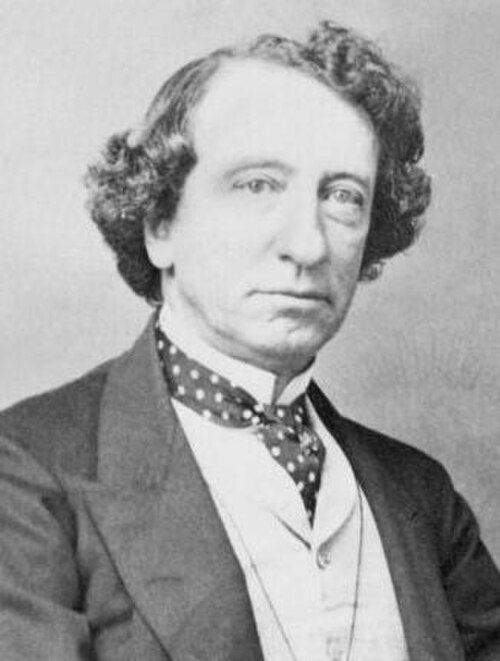
Biography
Sir John Alexander Macdonald was Canada's first prime minister, serving from 1 July 1867 to November 1873 and from October 1878 until his death in June 1891. He was born in Glasgow, Scotland, on 11 January 1815, and emigrated with his family to Kingston, Upper Canada, in 1820. He left school at 15 to article with a Kingston lawyer and was called to the bar in 1836. He gained early notice for defending clients in politically charged trials, including participants in the failed 1838 raid at the Battle of the Windmill.
Macdonald served as a Kingston alderman and in 1844 was elected to the Legislative Assembly of the Province of Canada for Kingston. He held several cabinet posts and in the 1850s helped build a Liberal-Conservative alliance with George-Étienne Cartier and his Quebec supporters, becoming joint premier. Persistent deadlock in the legislature led him to join his rival George Brown in the Great Coalition of 1864, which pursued a federal union of British North America. Macdonald played a leading role at the Charlottetown, Quebec and London conferences and drafted much of the resulting British North America Act. He was knighted in 1867.
As prime minister he won the elections of 1867 and 1872. His first government acquired Rupert's Land and the North-Western Territory from the Hudson's Bay Company. The transfer, made without consulting the Métis and First Nations who lived there, led to the Red River Resistance led by Louis Riel and to the Manitoba Act of 1870. British Columbia joined Confederation in 1871 on the promise of a railway to the Pacific, and Prince Edward Island in 1873. The government also signed the Treaty of Washington, passed the Trade Unions Act of 1872 and created the North-West Mounted Police in 1873. The Pacific Scandal, over campaign funds received from the railway promoter Sir Hugh Allan, forced him to resign in November 1873, and he lost the 1874 election.
Macdonald returned to power in 1878 on the National Policy, a program of protective tariffs, western settlement and a transcontinental railway, and won again in 1882, 1887 and 1891. During these years he represented, at various times, Victoria in British Columbia, Carleton and Kingston. His government chartered the Canadian Pacific Railway, which was completed in 1885 with heavy public support and the labour of thousands of Chinese workers. That same year the Chinese Immigration Act imposed a $50 head tax on Chinese immigrants, and the Electoral Franchise Act denied Chinese Canadians the federal vote.
Macdonald also served as superintendent general of Indian affairs from 1878 to 1887. In the early 1880s, as the bison disappeared, his government used the provision of food rations to press Prairie First Nations onto reserves, and many people suffered hunger and disease. In 1883 it began funding industrial residential schools intended to separate Indigenous children from their families and cultures, laying the foundation of a system later found by the Truth and Reconciliation Commission to have caused profound and lasting harm. Amendments to the Indian Act banned the potlatch and other ceremonies. In 1885 the government put down the North-West Resistance by force. Riel was convicted of high treason and hanged in November 1885 despite appeals for clemency, a decision that deeply divided English and French Canada, and eight Cree and Assiniboine men were hanged at Battleford.
Macdonald's first wife, Isabella Clark, died in 1857, and in 1867 he married Susan Agnes Bernard. He fought his final campaign in 1891, opposing unrestricted reciprocity with the United States. He suffered a stroke weeks later and died in Ottawa on 6 June 1891. He is buried in Cataraqui Cemetery in Kingston. His place in Canadian history has been re-examined in recent decades, and his record on Indigenous peoples and Chinese immigrants has led several communities to remove or relocate statues and to rename places bearing his name.
Public debt while in office
1867–1873
- Debt to GDP, taking office
- 29% (end-1870)
- Leaving office
- 27.5% (end-1873)
- Change
- -1.5 points of GDP
1878–1891
- Debt to GDP, taking office
- 41% (end-1878)
- Leaving office
- 37.9% (end-1890)
- Change
- -3.1 points of GDP
Gross public debt of all levels of government as a share of GDP at the year-end nearest each change of prime minister (IMF). Compare every prime minister.