20th Prime Minister of Canada
Jean Chrétien
Liberal prime minister of Canada, 1993–2003.
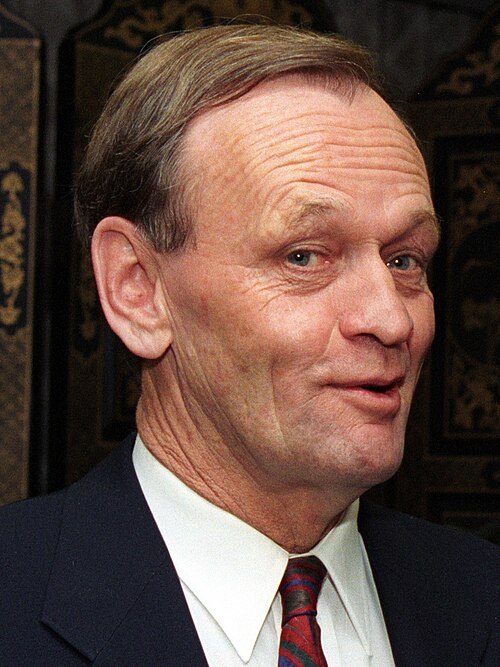
Biography
Joseph Jacques Jean Chrétien was born on 11 January 1934 in Shawinigan, Quebec, the eighteenth of nineteen children in a working-class family, of whom nine survived infancy. A condition in childhood left him deaf in one ear, and Bell's palsy left one side of his face partly paralyzed. He studied law at Université Laval and was called to the Quebec bar in 1958. In 1957 he married Aline Chaîné; they had three children. She died in 2020.
Chrétien practised law in Shawinigan before winning the riding of Saint-Maurice–Laflèche for the Liberals in 1963. He became a minister in 1967 and held a long series of portfolios, including national revenue, Indian affairs and northern development, the Treasury Board, industry, and finance, where he was the first francophone to serve. As minister of justice from 1980 to 1982 he campaigned for the No side in the 1980 Quebec referendum and negotiated the patriation of the Constitution and the Charter of Rights and Freedoms. He was later minister of energy and, briefly, deputy prime minister.
He finished second to John Turner in the 1984 leadership race, left Parliament in 1986 to practise law and published a memoir. He won the Liberal leadership in June 1990, returned to the Commons through a by-election in Beauséjour, New Brunswick, and was elected again in Saint-Maurice in 1993. In the election of 25 October 1993 the Liberals won a majority of 177 seats, and he was sworn in as the 20th prime minister on 4 November 1993.
Chrétien's government cancelled a contract for military helicopters and, through Paul Martin's 1995 budget, made deep spending cuts that led to a balanced budget in 1997–98, the first in nearly three decades. It created the national firearms registry in 1995 and replaced unemployment insurance with employment insurance. The 1995 Quebec referendum on sovereignty was defeated by a very narrow margin; the government then referred the question of secession to the Supreme Court and passed the Clarity Act in 2000, setting conditions for any future referendum.
The Liberals won further majorities in 1997 and 2000. The government signed the Social Union Framework Agreement with most provinces in 1999, sent Canadian forces to Afghanistan after the attacks of September 2001, ratified the Kyoto Protocol in 2002 and declined to join the invasion of Iraq in 2003. In its later years it faced controversy over the sponsorship program in Quebec and continuing rivalry with supporters of Paul Martin.
Chrétien announced in 2002 that he would retire and left office on 12 December 2003, when Martin succeeded him. He returned to the practice of law, published a memoir of his years as prime minister in 2007 and was appointed to the Order of Merit by Queen Elizabeth II in 2009.
Public debt while in office
- Debt to GDP, taking office
- 94.7% (end-1993)
- Leaving office
- 75.9% (end-2003)
- Change
- -18.8 points of GDP
- In dollars (at the time)
- $707.4 billion → $952.4 billion
Gross public debt of all levels of government as a share of GDP at the year-end nearest each change of prime minister (IMF). Compare every prime minister.