18th Prime Minister of Canada
Brian Mulroney
Progressive Conservative prime minister of Canada, 1984–1993.
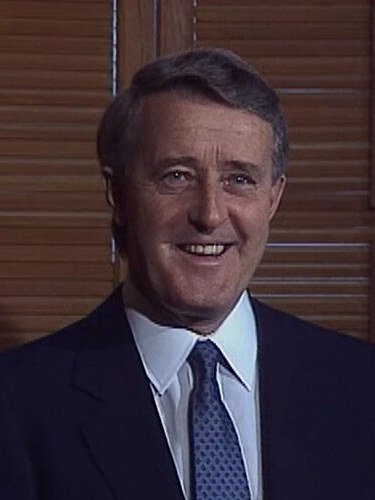
Biography
Martin Brian Mulroney was born on 20 March 1939 in Baie-Comeau, Quebec, the son of an electrician at the local paper mill. He grew up bilingual in a largely francophone town. He studied political science at St. Francis Xavier University in Nova Scotia, where he became active in the Progressive Conservative Party, and studied law at Dalhousie University and then Université Laval, graduating in 1964. He married Mila Pivnički in 1973; they had four children.
Mulroney joined a large Montreal law firm and built a career in labour law and negotiation. In 1974–75 he served on the Cliche Commission, which investigated violence and corruption in Quebec's construction industry. He ran for the Progressive Conservative leadership in 1976 without having held elected office and lost to Joe Clark. He then became president of the Iron Ore Company of Canada.
In June 1983 Mulroney defeated Clark for the party leadership and entered the House of Commons through a by-election in Central Nova that August. In the election of 4 September 1984, running in Manicouagan, he led the Progressive Conservatives to 211 seats, the largest number won by any party in Canadian history. He was sworn in as the 18th prime minister on 17 September 1984.
His first government dismantled the National Energy Program, replaced the Foreign Investment Review Agency with Investment Canada, privatized several Crown corporations including Air Canada and Petro-Canada, and apologized and offered redress to Japanese Canadians interned during the Second World War. In 1987 he reached the Meech Lake Accord with the premiers to secure Quebec's agreement to the Constitution, and his government negotiated the Canada–United States Free Trade Agreement. Free trade dominated the 1988 election, which the Progressive Conservatives won with a second majority.
In his second term the agreement took effect, and the government replaced the manufacturers' sales tax with the GST in 1991, appointing additional senators to pass the legislation. The Meech Lake Accord expired in 1990 without ratification, which contributed to the formation of the Bloc Québécois. The Charlottetown Accord, a broader constitutional package, was rejected in a national referendum in 1992. His government signed the Acid Rain Accord with the United States in 1991, sent forces to the Gulf War, opposed apartheid in South Africa, negotiated NAFTA with the United States and Mexico, and reached the land claims agreement that led to the creation of Nunavut.
Facing low public support, Mulroney announced his retirement in February 1993 and left office on 25 June 1993, when Kim Campbell succeeded him. He returned to the practice of law in Montreal and served on corporate boards. In 1997 the federal government settled a defamation suit he had filed over allegations about the purchase of Airbus aircraft; a later public inquiry examined cash payments he received from a businessman after leaving office. He published his memoirs in 2007. He died on 29 February 2024 in Palm Beach, Florida, at the age of 84, and was given a state funeral in Montreal.
Public debt while in office
- Debt to GDP, taking office
- 60.2% (end-1984)
- Leaving office
- 88.2% (end-1992)
- Change
- +28 points of GDP
- In dollars (at the time)
- $278.1 billion → $633.7 billion
Gross public debt of all levels of government as a share of GDP at the year-end nearest each change of prime minister (IMF). Compare every prime minister.