9th Prime Minister of Canada
Arthur Meighen
Conservative prime minister of Canada, 1920–1921 and 1926.
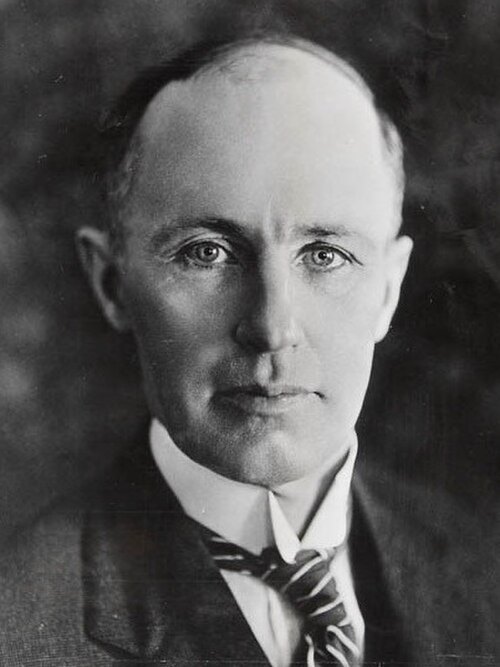
Biography
Arthur Meighen was born on June 16, 1874, on a farm near Anderson, in Perth County, Ontario. He attended high school in St. Marys and studied mathematics at the University of Toronto, graduating in 1896. He taught high school briefly in Ontario before moving to Manitoba in 1898.
Meighen settled in Portage la Prairie, where he studied law and was called to the Manitoba bar in 1903. He practised law there and was active in local business and the Conservative Party. In 1904 he married Isabel Cox, a schoolteacher; they had two sons and a daughter.
Meighen was elected to the House of Commons for Portage la Prairie in 1908 and quickly became known as a skilled debater. In 1913 he drafted the rules that allowed the government of Robert Borden to impose closure on debate, and that year he became solicitor general, joining the cabinet in 1915. During the First World War he played a central role in drafting and passing the Military Service Act of 1917, which introduced conscription, and the Wartime Elections Act. As secretary of state and then minister of the interior, he oversaw the takeover of bankrupt railways that formed Canadian National Railways. During the Winnipeg General Strike of 1919 he was acting minister of justice and supported legislation to deport strike leaders and to broaden the law on sedition.
When Borden retired, the Unionist caucus chose Meighen as leader, and he became prime minister on July 10, 1920, at the age of 46. His government faced economic recession, opposition in Quebec over conscription, and farmer discontent in the West. In the election of December 6, 1921, the Conservatives finished third behind the Liberals and the Progressives, and Meighen lost his own seat. He returned to the House for Grenville, Ontario, in a by-election in 1922 and led the Opposition.
In the 1925 election the Conservatives won the most seats and Meighen regained Portage la Prairie, but Mackenzie King remained in power with Progressive support. In June 1926, after Governor General Lord Byng refused King's request for a dissolution, Meighen agreed to form a government and became prime minister again on June 29, 1926. Because ministers then had to seek re-election on appointment, he named most of them as acting ministers. The government was defeated by one vote on July 2, and in the election of September 14, 1926, the Liberals won and Meighen again lost his seat. He resigned as party leader that year.
Meighen moved to Toronto and worked in finance and investment. In 1932 R. B. Bennett appointed him to the Senate, where he served as government leader until 1935. In November 1941 he was again chosen as Conservative leader, resigned from the Senate and sought a seat in the York South by-election of February 1942, but he lost to the Co-operative Commonwealth Federation candidate. He stepped down as leader later that year and returned to private business. He died in Toronto on August 5, 1960, and was buried in St. Marys, Ontario.
Public debt while in office
1920–1921
- Debt to GDP, taking office
- 58.4% (end-1920)
- Leaving office
- 74.1% (end-1921)
- Change
- +15.7 points of GDP
1926–1926
- Debt to GDP, taking office
- 64.9% (end-1925)
- Leaving office
- 62.9% (end-1926)
- Change
- -2 points of GDP
Gross public debt of all levels of government as a share of GDP at the year-end nearest each change of prime minister (IMF). Compare every prime minister.