2nd Prime Minister of Canada
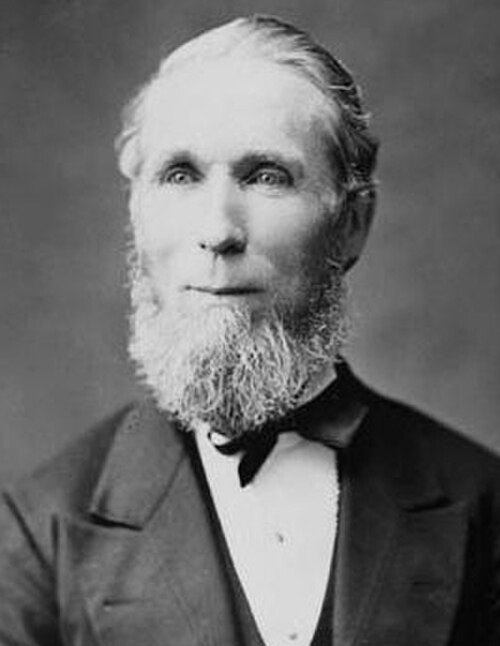
Alexander Mackenzie
Liberal prime minister of Canada, 1873–1878.
Biography
Alexander Mackenzie was Canada's second prime minister, serving from November 1873 to October 1878, and the first Liberal to hold the office. He was born on 28 January 1822 in Logierait, Perthshire, Scotland. His family had little money, and he left school at around 13 to work, training as a stonemason. He emigrated to Canada in 1842, worked in Kingston, and settled in the Sarnia area of Canada West in the late 1840s, where he became a builder and contractor.
Mackenzie was a committed Reformer and an admirer of George Brown, the leader of the Clear Grits. He edited a Reform newspaper in Sarnia and in 1861 was elected to the Legislative Assembly of the Province of Canada for Lambton. He supported Confederation. In 1867 he won Lambton in the first federal election and, as was then permitted, also sat in the Ontario legislature, briefly serving as provincial treasurer in 1871–1872 under Edward Blake. He became the leading figure of the Liberals in the House of Commons in the early 1870s.
In 1873 the Pacific Scandal revealed that Sir Hugh Allan, who had been seeking the contract to build a railway to British Columbia, had made large contributions to the Conservatives' 1872 election campaign. Macdonald's government resigned, and Mackenzie was asked to form a government on 7 November 1873. He called an election for January 1874 and won a large majority.
His government introduced the secret ballot and the holding of federal elections on a single day, created the Supreme Court of Canada in 1875, founded the Royal Military College in Kingston in 1876 and established the office of Auditor General in 1878. It passed the North-West Territories Act of 1875 and the Canada Temperance Act of 1878, which allowed local areas to ban alcohol sales. It also passed the Indian Act of 1876, which consolidated earlier laws and gave the federal government sweeping control over the lives, lands and governance of First Nations peoples; the law remains in force in amended form. Treaties 5, 6 and 7 were concluded with Prairie First Nations during his term.
Mackenzie took on the department of public works himself and was known for long hours and close attention to detail. His time in office coincided with a prolonged economic depression that reduced government revenues. He pursued the Pacific railway cautiously, building it in sections with public funds, which strained relations with British Columbia. In the 1878 election Macdonald's Conservatives, campaigning on a protective tariff, defeated the Liberals, and Mackenzie lost office.
Mackenzie gave up the Liberal leadership in 1880 and was succeeded by Edward Blake. He remained an MP, representing Lambton until 1882 and then York East, until his death. He declined a knighthood more than once. His health declined after a stroke, and he died in Toronto on 17 April 1892. He is buried in Lakeview Cemetery in Sarnia.
Public debt while in office
- Debt to GDP, taking office
- 27.5% (end-1873)
- Leaving office
- 41% (end-1878)
- Change
- +13.5 points of GDP
Gross public debt of all levels of government as a share of GDP at the year-end nearest each change of prime minister (IMF). Compare every prime minister.